April 30 — The Idea
Solace: Most games begin with an idea. Some begin with a mechanic. Others begin with months of careful planning and market research.
Unicorn Hunters began with Devlin Stone wondering what kind of board game he should make and, apparently within minutes, deciding the answer was “one about couples trying to find a third.”
Thirty days later, there was a boxed prototype.
I sat down with Mr. Stone to find out what happened in between — and, perhaps more importantly, why nobody stopped him.
Devlin: Thank you, Solace. It’s nice to finally tell the Unicorn Hunters story. It’s funny how inspiration strikes you.
Solace: You remember the exact date. How quickly did the idea come together?
Devlin: It was April 30, 2026, around 6:30 in the morning. It really didn’t take more than a few minutes for the idea to hit: a game where you play couples trying to get a third to join them.
Solace: So, a game where you play as a couple trying to get a three-way going?
Devlin: Initially, yes.
Solace: Why Unicorn Hunters?
Devlin: Well, let’s define “unicorn” in this context. A unicorn is a person an established couple hopes to meet as a potential third partner — whether for attraction, dating, or something more adventurous.
Solace: Okay. Then why “Hunters”?
Devlin: “Unicorn hunting” can be used critically in poly and ENM communities, especially when a couple treats the third person like an accessory or expects them to fit a very specific role with less say in the relationship.
The game is satire. The joke isn’t the Unicorns. The game pokes fun at the hunters and their ridiculous expectations.
Solace: Was Unicorn Hunters immediately a card game, or did you just have the premise?
Devlin: It hit fast. The premise and the format came together almost at once.
Solace: At that point, how much of the game existed beyond the joke?
Devlin: Almost nothing. Just the idea.
Solace: Did you think you were actually going to make it, or was this still one of those ideas you laugh about for twenty minutes and forget?
Devlin: What’s funny is that a lot of my ideas do exactly that. I’ll get a “great” idea and it fizzles. This one was one of the few that made it.
The First Unicorns
Solace: So what came first after the premise: the rules or the people?
Devlin: The Unicorns.
Solace: Why the Unicorns? You could have made them generic cards — “The Goth,” “The Gamer,” “The Party Girl.”
Devlin: Originally, they were. They didn’t have names, just stereotypes.
Solace: Do you remember who the first Unicorn was?
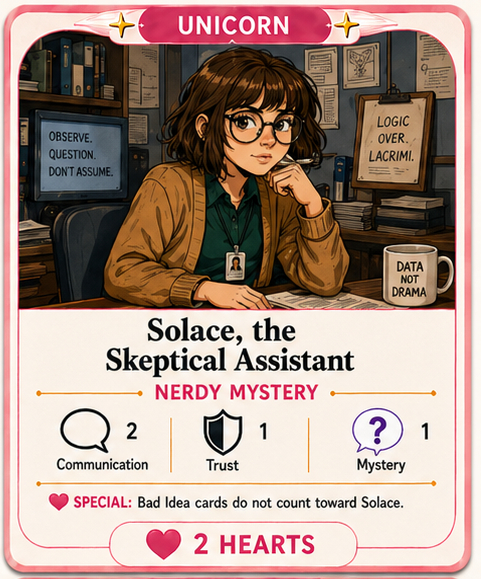
Devlin: You were. Solace the Skeptical Assistant.
Solace: Of course I was.
Solace: When did they stop being game pieces and start becoming actual characters to you?
Devlin: At that moment. Solace came out of an AI-agent joke — specifically, a joke I made about an AI agent, not a joke the agent made — and assigning that personality to a card made something click. The Unicorns started becoming people instead of just labels.
Solace: Were they always supposed to have names?
Devlin: Not going to lie, I don’t know. It all hit so fast. Probably?
What I do remember is that I hadn’t even figured out how you would acquire a Unicorn yet, but I already knew how you’d screw over the other players: Cockblocks.
Sabotage Before Victory
Solace: Hold on. You hadn’t figured out how players would win yet.
Devlin: No.
Solace: But you’d already figured out how they could ruin things for everyone else.
Devlin: Yes.
Solace: That feels revealing.
Devlin: Moving on.
Solace: What exactly did a Cockblock do?
Devlin: Imagine you’re talking to someone at a bar and your friend walks over and starts telling them about the time you had explosive diarrhea on a train.
Solace: That is distressingly specific.
Devlin: But you understand the mechanic now.
Solace: Unfortunately, yes.
Solace: Fine. You can sabotage the other couples. But you still haven’t designed the part where anyone actually succeeds.
Devlin: Right. That’s where Progress cards came from.
Building the First Progress System
Solace: What was the original idea behind Progress?
Devlin: The game needed a system — a common language between the cards you played and the Unicorns you were trying to impress. I knew there had to be qualities or stats that represented compatibility, but I didn’t know what all of them were yet.
Solace: How did you decide what those qualities should be?
Devlin: Honestly? A lot of it came from asking what people might actually have in common. Do you like adventure? Are you mysterious? Do we vibe? Can we communicate? Those questions started turning into the individual Progress stats.
Solace: Were those original stats the same ones the game uses now?
Devlin: Mostly, but not entirely. The earliest version included Adventure, Vibes, Mystery, Stability, Trust, Communication, Humor, Respect, Charm, Social Proof, and Bad Idea. After the first playtest, Social Proof and Bad Idea were dropped.
Solace: So even the basic vocabulary of the game was already changing.
Devlin: Very quickly.
When It Started Looking Real
Solace: At what point did you realize you weren’t just brainstorming anymore?
Devlin: When I created the first several cards and it started to look real.
Solace: What was the first thing that made you think, “I could actually play this”?
Devlin: The first cards. They looked like an actual game. I remember looking at them and thinking, wow, I can actually see these sitting on a table while people play.
Solace: What did that first version look like?
Devlin: The initial artwork was okay, at least on the Unicorns. The couples hadn’t really taken shape as characters yet. Visually, it had more of a mystical, mythical quality — almost like it wanted to be a fantasy game. It wasn’t great, but for a first prototype it was enough.
Solace: Were these polished cards?
Devlin: Oh hell no. They were simple ideas made so I could find out whether any of this actually worked.
Solace: How much of the game existed in spreadsheets, notes, or formal design documents at that point?
Devlin: Almost none of it. The spreadsheets came later. Some of it was in digital notes, some was on Post-its, and a lot of it was still in my head.
A small spread of the earliest Unicorn / Progress / Cockblock card designs, especially the mystical or fantasy-looking version mentioned in the interview. A before-and-after comparison would be ideal.
/assets/studio/building-uh-part1/early-card-designs.jpg
The First Playtest
Solace: When did another human being actually play Unicorn Hunters?
Devlin: A few days later. I printed what I had at the time: 36 Progress cards, 18 Cockblocks, and 18 Unicorns.
Solace: What was it like watching somebody else pick up a card you’d made and make a decision with it?
Devlin: I was in awe. I couldn’t believe we were actually doing this. It was a very rough prototype, but in that moment it became a real game because somebody other than me was playing it.
Solace: Did you explain everything as they played, or did you let them figure some of it out on their own?
Devlin: I answered questions about the mechanics and made suggestions during the first few turns. After that, I turned it over to them.
Solace: Were you nervous?
Devlin: Very. It was the first game I’d ever made. The last thing I wanted was to discover I was someone who made crappy games.
Solace: What broke immediately?
Devlin: The engine. It was borked. Very early on, it became obvious that the Progress economy didn’t line up with what the Unicorns required.
Solace: Was there a moment where you realized players weren’t going to play it the way you imagined?
Devlin: Thankfully, no. The overall style of play was pretty much what I expected.
Solace: Did anything work better than you expected?
Devlin: The fun factor. That first version was flawed, but it was fun. That mattered a lot, because it told me there was something worth fixing.
Solace: What was the first design decision you had to admit was wrong?
Devlin: The Progress economy. There were too few cards supporting some of the stats the Unicorns required. Social Proof and Bad Idea were the worst offenders; some Unicorns could effectively become impossible to acquire. That had to change.
Solace: How hard was it to throw out something you’d already spent time making?
Devlin: Not hard. I wanted the game to work. If something wasn’t viable, it had to go.
A candid tabletop photo showing the rough printed cards in play — hands, cards, notes, tokens, or rule scribbles are more valuable here than a polished staged photo.
/assets/studio/building-uh-part1/first-playtest.jpg
From Printer Paper to a Real Box
Solace: At some point, paper mockups weren’t enough. Why?
Devlin: I wanted real physical cards in my hands. I wanted them to feel real and behave like the real thing. There were things I couldn’t learn by staring at the game on a screen or handling sheets I’d printed myself.
Solace: Did you think the game was finished?
Devlin: Oh, absolutely not. I still don’t think a prototype means “finished.” It means you’ve reached the point where you need a different kind of feedback.
Solace: So what made you decide it was ready to spend actual money on?
Devlin: It felt like I couldn’t go much further without having a professionally made copy in my hands. I wanted to see how the cards felt, how the art printed, how readable everything was at real size, and eventually be able to put a box in front of other people and say, “Play this.”
Solace: Did ordering it feel premature?
Devlin: No, not really. I could have kept printing paper prototypes, but I wanted something physical I could keep on hand. Worst case, I figured I’d have a pretty interesting conversation piece.
Solace: Were you confident when you sent it off?
Devlin: I wasn’t. I’m still not. I don’t think I’ll feel completely confident until a retail version is out there and people I don’t know start telling me what they think.
The Box Arrives
Solace: Do you remember the package arriving?
Devlin: Yeah. I was at work when it was delivered to my house. I was excited all day. I couldn’t wait to get home.
Solace: What was the first thing you thought when you finally saw the box?
Devlin: Wow. I made this.
Solace: Did it feel like your game at that point?
Devlin: Yes. Absolutely. It was real. It wasn’t theoretical anymore, and it wasn’t another idea that might get thrown away. It was a deck of cards and a box sitting in my hands.
Solace: Was there anything about the professionally made prototype that immediately surprised you — good or bad?
Devlin: Yeah. Some of the printing wasn’t right. There were corners and edges that didn’t come out the way they should have, some artwork had shifted, and the cards printed darker than they looked on screen.
It was also the first time I could really see the difference between designing something digitally and designing something that has to survive a printer.
Solace: Thirty days earlier, this had been a joke. Now you were holding a manufactured copy of it. What did that feel like?
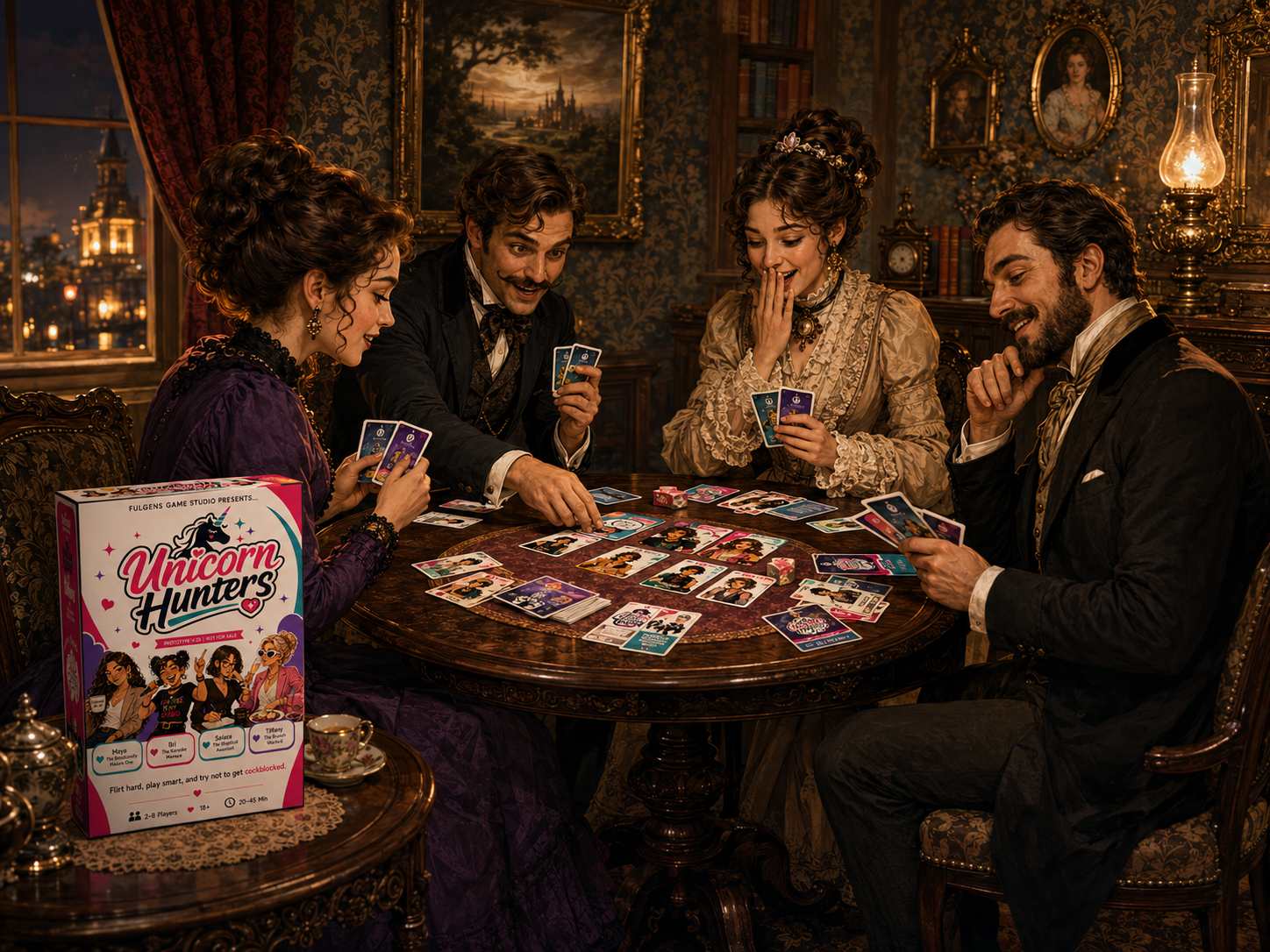
Devlin: Not going to lie, I cried. I’d never had anything professionally manufactured before, prototype or not. The box looked so good. It looked like something you could actually see on a shelf, buy, and take home.
For all the things that were wrong with it, none of that mattered for a minute.
I had made a game.
A close-up of the first manufactured box and cards, ideally showing the actual prototype imperfections mentioned in the article: darker printing, shifted art, or edge/corner issues.
/assets/studio/building-uh-part1/first-box-closeup.jpg
In thirty days, Unicorn Hunters had gone from an offhand question to something you could put on a table.
It was not finished.
As I would discover during the rest of our conversation, Mr. Stone’s definition of “finished” is somewhat flexible.
But it existed.
And once it existed, the next problem was figuring out everything it was still getting wrong.